
Re-Roofing in Plymouth
A full strip and recover when a roof has genuinely reached the end of its life — with battens, underlay and fixings specified for the exposure of your street, not a generic spec.
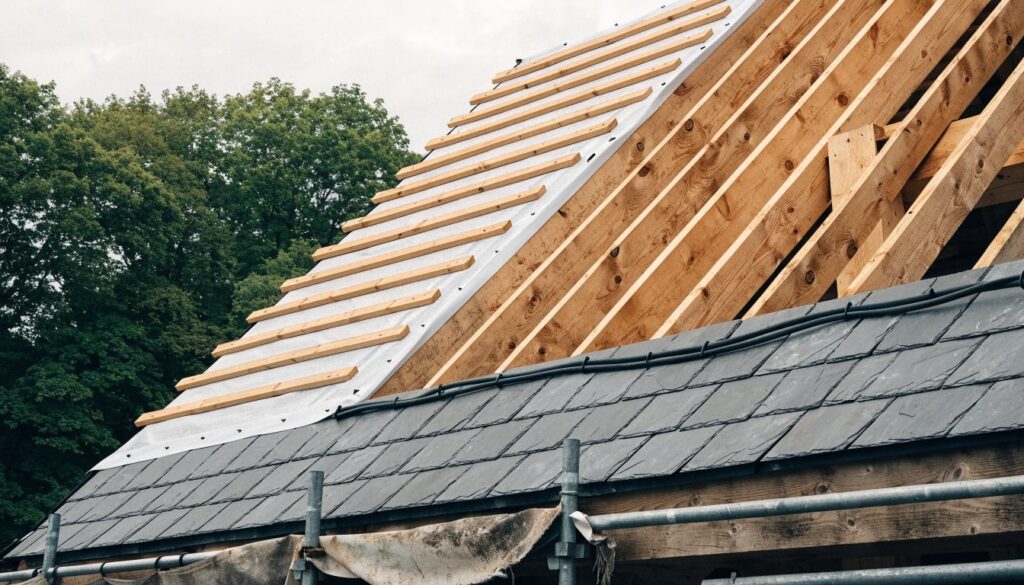
When re-roofing is the honest answer
We would rather repair a roof than replace it, and we will say so when a repair will hold. But there is a point where the fixings across a whole slope have gone, where previous patches are now the problem, or where the timber underneath has taken too much water for too long. At that point another repair is just money spent on delay.
What we will not do is arrive at a small leak and leave having sold you a new roof. If we recommend re-roofing, we will show you why — the state of the nails, the condition of the battens, what the underlay is doing — and you can decide.
What a re-roof actually involves
- Strip and inspect. The old covering comes off and the structure underneath gets looked at properly. Rafters, wall plates and any previous repairs are assessed before anything goes back on.
- Underlay and battens. Breathable underlay and treated battens, with the batten gauge set out for the covering and the pitch rather than eyeballed.
- Fixings for the exposure. Plymouth is a coastal, south-west-facing site. Nail and clip specification follows from that, and from BS 5534.
- Dry-fixed ridge, hip and verge. Since the 2018 amendment to BS 5534, mortar alone is no longer relied on to resist wind uplift at these details.
- Leadwork renewed. Abutments, soakers, flashings and valleys are replaced as part of the job rather than reused where they have already had a life.
- Site left clean. Old slate and debris removed, and the ground checked over before we go.
The prevailing wind across South West England is predominantly south-westerly, and the Met Office describes the region as one of the more exposed parts of the UK, with average wind speeds higher only in western Scotland. In Plymouth, that prevailing direction comes in off the Sound.
Source: Met Office, South West England: climate.
Older roofs and non-traditional construction
Not every Plymouth house is conventional. In North Prospect, the council’s own area planning statement records steel-framed DorlonCo and precast concrete Stonecrete houses from the city’s first council housing scheme under the 1919 Addison Act, many now in poor structural condition, under hipped roofs with grey slate or brown tiles. That kind of construction needs to be identified before a re-roof is priced, because what it can carry and how it can be fixed are both different.
If you are in a conservation area
Plymouth has 15 conservation areas. Re-covering like for like is usually straightforward, but material choice can matter, and anything that alters the roof form needs permission — a dormer or roof enlargement is never permitted development in a conservation area. We check the constraints on your specific address before quoting. Related: roof repairs and leadwork.
Get your free, no-obligation quote today
Tell us what is going on with your roof and we will get back to you quickly with honest advice and a clear, written quote.
Request a Free QuoteRoofer Plymouth
Roofing contractors covering Plymouth and the surrounding areas. Service-area business — we come to you.