
Roof Repairs in Plymouth
Slipped slates, leaks around chimney stacks, failed valleys and parapet gutters. We find where the water is actually getting in, not just where it shows up inside.
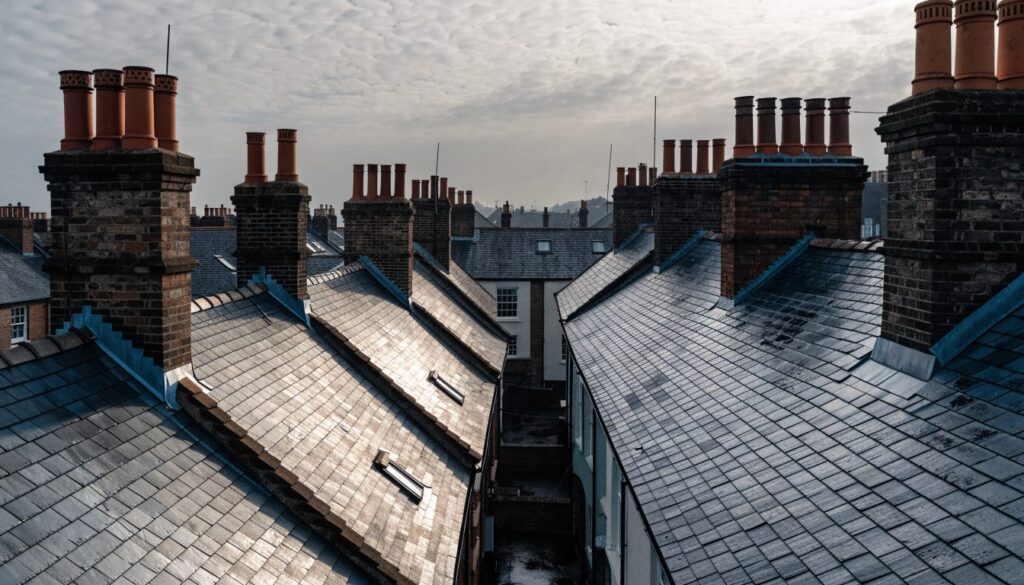
Where Plymouth roofs tend to fail
A leak almost never starts where the stain appears on your ceiling. Water tracks along battens, rafters and lead before it drops, so the first job is always to work out the real entry point. On the roofs we see across the city, a handful of failure points come up again and again.
- Slipped and broken slates after a south-westerly blow. On older nailed roofs the fixings corrode long before the slate itself gives up, and one slipped slate quickly becomes several.
- Lead around chimney stacks on the Victorian and Edwardian terraces of Peverell, Mutley, Mannamead, Stoke and Lipson. Soakers and flashings that were sized correctly a century ago have often been patched with mortar or sealant since.
- Valley failures where two pitches meet, particularly on the larger villa roofs. Debris collects, water backs up under the slates, and the timber underneath takes the damage.
- Parapet gutters behind the front wall on Georgian and reconstruction-era buildings. They are hidden from the street, so they are usually found late.
- Flat roof junctions where a modern extension meets an older pitched roof. The upstand detail is where these nearly always let go.
Repair or replace — an honest answer
Some roofs need a slate put back and nothing more. Others have reached the point where every repair simply moves the problem a metre along. We will tell you which one you have, and show you what we found rather than asking you to take it on trust. If a repair is the sensible answer, that is what we will quote for.
BS 5534, the code of practice for slating and tiling, was amended in 2018 to withdraw any reliance on the tensile strength of mortar bedding to resist wind uplift. On an exposed site like Plymouth that matters: ridges, hips and verges that were once simply bedded in mortar are now specified as mechanically or dry-fixed systems.
Source: BS 5534:2014+A2:2018, Slating and tiling for pitched roofs and vertical cladding — Code of practice.
After a storm
The Met Office records around 16 days a year at Plymouth where the wind reaches a mean speed of 34 knots or more over ten consecutive minutes — the formal definition of a gale. Inland, Yeovilton sees about 7 and Long Ashton near Bristol about 4. If your roof has just lost slates in a blow, that is not unusual here, and it is worth having the rest of the roof looked at at the same time rather than replacing one slate and waiting for the next front to come through. See our emergency callouts page if you need someone quickly.
Conservation areas
If you are in one of Plymouth’s 15 conservation areas, a like-for-like repair is generally straightforward, but anything that changes the roof — a dormer, an enlargement, a new opening — needs permission first. We flag that before quoting rather than after. There is more detail on our Plympton page and in the guide on our home page.
Get your free, no-obligation quote today
Tell us what is going on with your roof and we will get back to you quickly with honest advice and a clear, written quote.
Request a Free QuoteRoofer Plymouth
Roofing contractors covering Plymouth and the surrounding areas. Service-area business — we come to you.